/hieroglyph-paint
AI Hieroglyph Body Paint Nudes
Make it with your museAI Hieroglyph Body Paint Nudes
Open this world on the wall, and make it with your muse.
all 9 frames of her, in this world ↓
The Painted Register: Gold, Lapis, Torchlight and a Pool
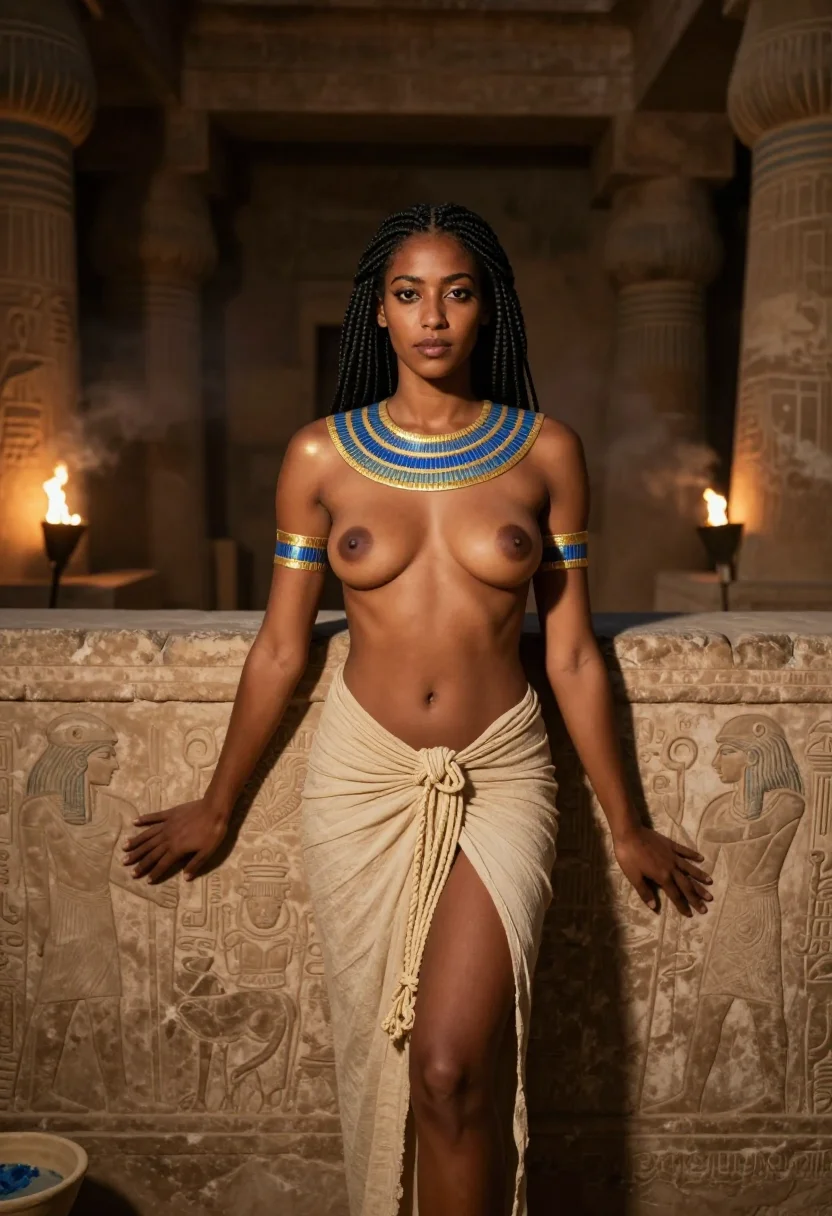
This pack takes body paint at its word. Gold and lapis hieroglyph bands are painted across the collarbones, the ribs and the upper arms, and for most of the nine frames they are the only covering there is. The setting gives them somewhere to be: a sandstone relief wall cut in sunk carving with its own painted figures, a broad step with a paint bowl and brush set down on it, torches throwing a small warm light across everything in lapis and gold, and a stone pool cut into the temple floor at the end. The egyptian body paint nude earns its nudity from the pigment rather than from a pose.
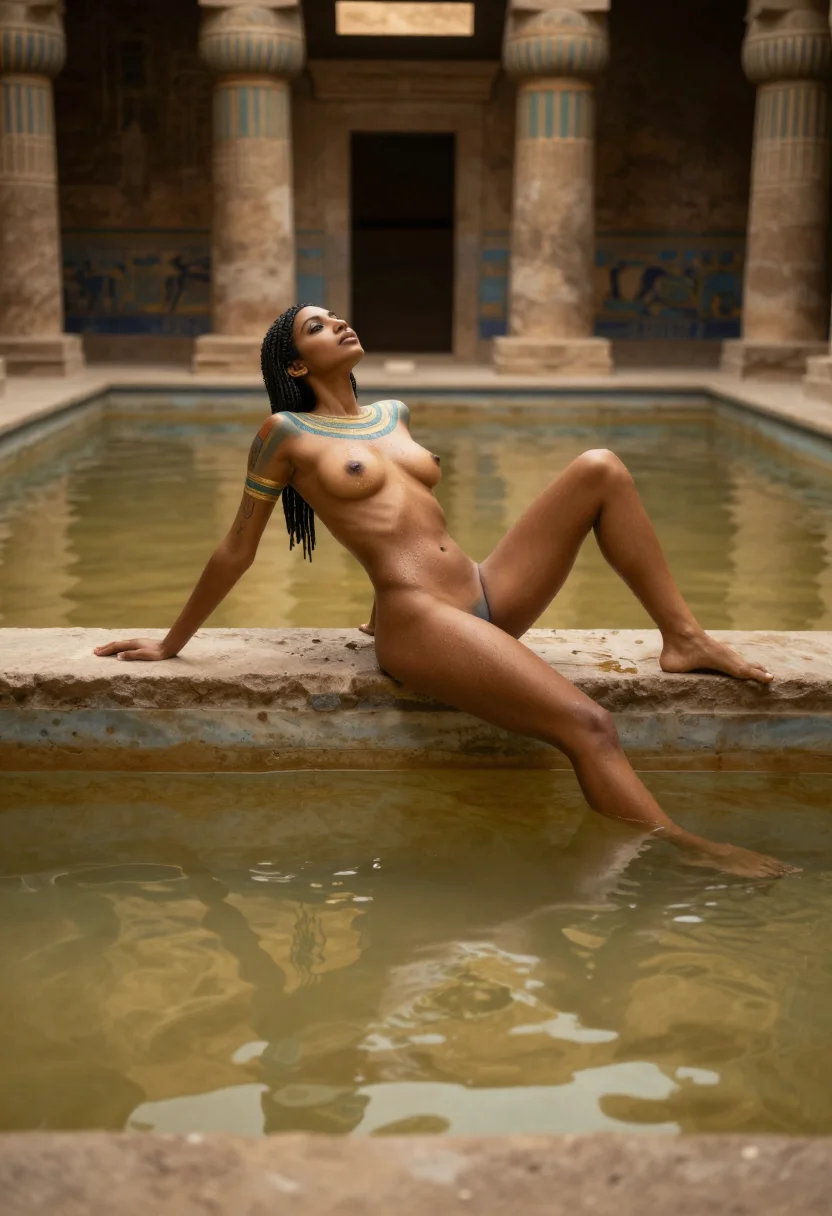
Three lighting conditions carry the nine frames, and water is what moves between them. The opening third is the crispest: torchlight rakes across dry pigment, finding the ridge of every band, with the wall's ochre behind and the linen at the hips still knotted. The middle third is the warmest — the torch is nearer the step, gold reads at its brightest and lapis at its deepest, and the sandstone throws a soft bounce back up. The last third is the softest and the strangest: the pool clouds gold around her waist, wet paint smears take a specular the dry bands never had, and the torch arrives scattered off moving water.
Exposure moves one step per third and never lands halfway. Linen at the hips with the bands crisp; then the linen folded on the step and the paint alone; then nude in the water with the paint running. The brush and bowl are always set down, never held — the pack shows a painted woman, not a painting in progress.
The pose craft holds across all nine. A hand rests on the carved relief, on the cord's knot, on the stone beside her, on a thigh, or on the pool's rim behind her; the seated frames keep the elbow low and the shoulders open; no limb is pointed at the camera in any frame. No legible text appears in the paint or on the wall. The muse is unambiguously an adult woman throughout.
All nine frames are photographic in construction and AI-generated in execution — specular on wet gold, the matte depth of lapis, sandstone grain and clouded water rendered from photographic principles rather than drawn or painted. The New Kingdom is borrowed here for its surfaces and its palette; these are AI nudes in the strict sense — composed frames rather than captured ones, documenting no real temple and no real woman.
Frequently asked questions
- What is in the AI Hieroglyph Body Paint Nudes pack?
- Nine frames at one temple, in three states. At the wall: gold and lapis hieroglyph bands painted across the collarbones, ribs and upper arms, linen worn at the hips on a knotted cord, one hand on the wall's carved relief and the other at the knot, torchlight raking the gold. On the step: the linen folded aside, the paint the only covering, seated with one hand flat on the stone and the other on a thigh circled by a gold band, a paint bowl and brush set down at the step's edge. In the pool: nude to the hips in water, the paint half-washed and running gold and blue down the arms and ribs, both hands resting on the stone rim behind her. Three frames per state, one payment for the set.
- Are these real photographs or AI-generated?
- AI-generated, built on photographic principles. Torchlight is a small, warm, moving source — it rakes across pigment and finds every ridge of a dried gold band, throws hard speculars off wet paint, and leaves lapis matte and deep beside it. Water in the last third clouds gold around the waist and scatters the same torch into something much softer. Dry pigment, wet pigment, sandstone and skin each answer that light differently. It reads as a photograph made in that temple, not as an illustration of one.
- Why is body paint the right garment here?
- Because it is the only one that gets more interesting as it fails. A dress hangs the same way all evening; painted hieroglyph bands are crisp and architectural when they are dry, and become something else entirely once water reaches them. The set is built on that arc — the paint as a garment in the first third, as the whole covering in the second, and as gold running down the ribs in the third.
- What do the hieroglyphs say?
- Nothing. No legible text appears anywhere in the pack, on the skin or on the wall — the bands are pattern, colour and rhythm rather than a sentence, and the wall's carved figures are ornament. That is a deliberate rule of the set: the paint is a garment, not a caption, and reading it would pull attention out of the frame.
- How is this different from the Pharaoh's Bedchamber pack?
- Pharaoh's Bedchamber is the domestic and private side of the same century: a low bed, an alabaster lamp, a linen canopy let down, gold anklets and an ankh amulet. This one is public architecture and pigment — sandstone, torch flame, a temple pool, and gold body paint instead of linen. If you want the bedchamber, start there; if you want the painted body, start here.
- What is she wearing across the nine frames?
- Gold and lapis hieroglyph bands across the collarbones, ribs and upper arms throughout, plus fine linen at the hips held by a knotted cord in the opening third. The linen is folded on the temple step for the middle third and stays there. In the last third the water takes half the paint with it. A gold band at the thigh and gold at the wrists carry through all nine. Every frame is a settled state rather than a step between two of them.
- Is the Egyptian temple historically accurate?
- Period-shaped rather than museum-exact. Sunk relief on sandstone, a torch-lit hall, a stone pool cut into the floor and pigment in gold and lapis are drawn from New Kingdom temple building and painting; the pack borrows that register for its light and its surfaces, and documents no real temple, no real ritual and no real person.
- Why does the paint look different in each third?
- Because pigment behaves differently dry, lit and wet. In the first third it is bone dry and crisp, so the bands read as hard geometry with torchlight catching their edges. In the second the paint is the only covering and the torch is closer, so the gold reads warmest and the lapis darkest against the sandstone's ochre. In the third the pool has taken half of it — gold and blue run down the arms in soft smears, the water clouds gold at the waist, and wet paint throws a specular the dry paint never did.
- Do I need to upload a selfie?
- It is optional. One clear front-facing photo casts the muse in your likeness across all nine frames; skip it and the house casts its own. Your selfie steers the face only — it is never the image being worked on.
- Is this a Candy AI or Promptchan alternative?
- Adjacent territory, different product. Candy AI is a chat you steer; Promptchan is a prompt box you refine one image at a time. This is a pre-engineered nine-frame series — one temple, three states of the same paint, three lighting conditions — delivered whole for one payment. Better if you want a coherent set, worse if you want to negotiate every frame.
- Can I use the frames once unlocked?
- Personal and creative use. Not for commercial redistribution, not to present as a real person's photograph, and not for use against any individual.
- Is this explicit? Is there an age requirement?
- The pack contains adult nudity and access requires confirming you are 18 or over. The muse is an adult woman composed from a written brief rather than photographed — a synthetic archetype, not a real person and not a depiction of any living or historical individual. If you cast your own face into the set, that likeness is yours by your own choice and yours alone.
- Who is in the photos?
- A muse you choose. 32 AI faces, none of them a real person.
Who Reaches for the Painted Register
- People whose search was a body paint nude and who want pigment as the whole garment rather than a festival stripe
- Anyone building an egyptian body paint set that has to hold one location and one grade across nine images
- Photographers studying how torchlight rakes dry pigment and how water changes what the same paint does
- Body-paint artists and makeup people looking at how gold and lapis bands sit on collarbones, ribs and upper arms
- Writers and worldbuilders who need one consistent character through a single temple evening
- Collage and moodboard makers who need photographic-quality painted-nude material rather than studio glamour
- Art nude and body paint art readers who want pigment treated as wardrobe rather than as decoration
- Adults curious about the historical register of AI photography, in torchlight rather than a softbox
About Ovid
Ovid is a house of pictures that were never taken. Most AI image tools ship one giant catalog of poses and aesthetics; the output looks like every other generated image on the internet. Ovid goes the other way. Each pack is a single editorial brief — light, styling, scene composed in the grammar of the great fashion editorials — hand-curated against real references and tested before it ships. Free preview before you pay. Packs are one-time. No template generator, no feed. A fashion house, not a catalog.