/punjabi-kudi
AI Punjabi Kudi Nudes
Make it with your museAI Punjabi Kudi Nudes
Open this world on the wall, and make it with your muse.
all 9 frames of her, in this world ↓
The Punjabi Kudi Register
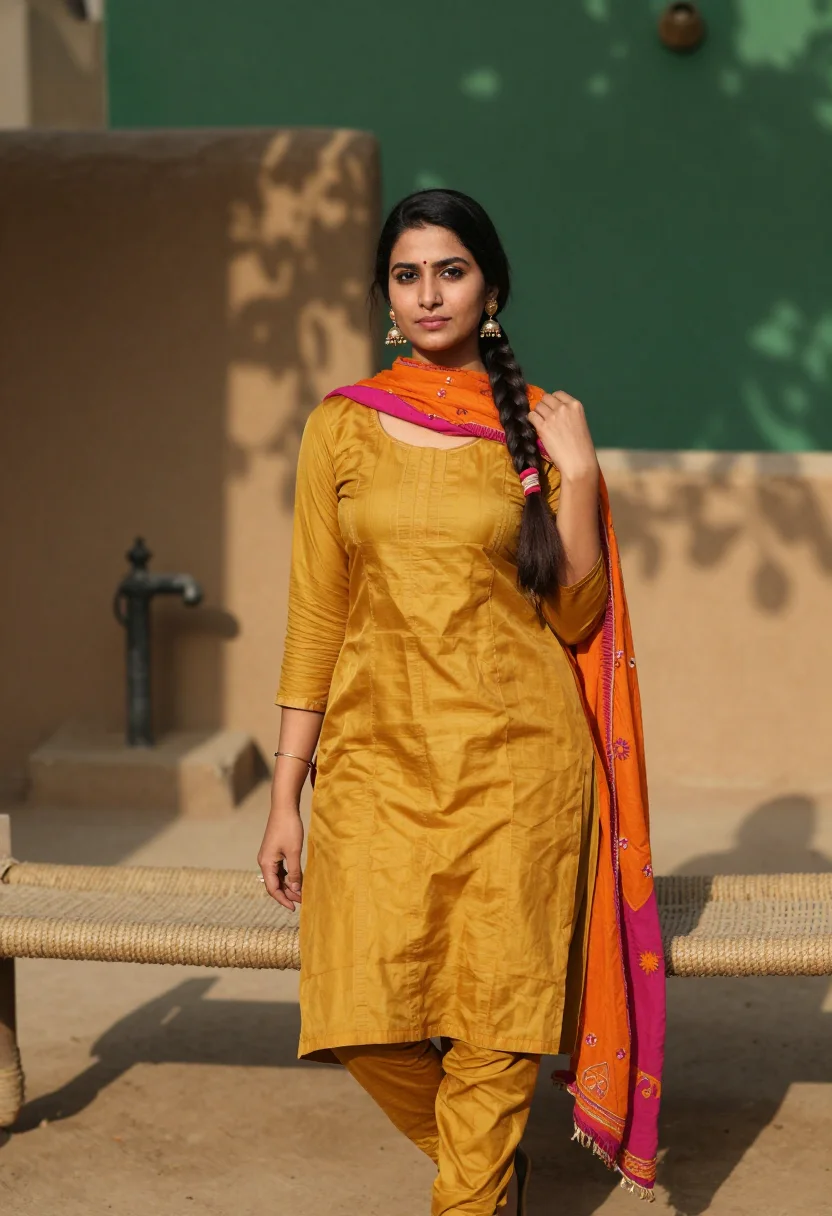
This is the pind kudi — the village girl-next-door of Punjabi song, the courtyard hers while the tractor and the men are out for the wheat-cutting weeks. The register is built from the courtyard itself: a charpai in the shade, a hand-pump against the wall, a peepal tree breaking the afternoon light, a steel tumbler of lassi on the ground.
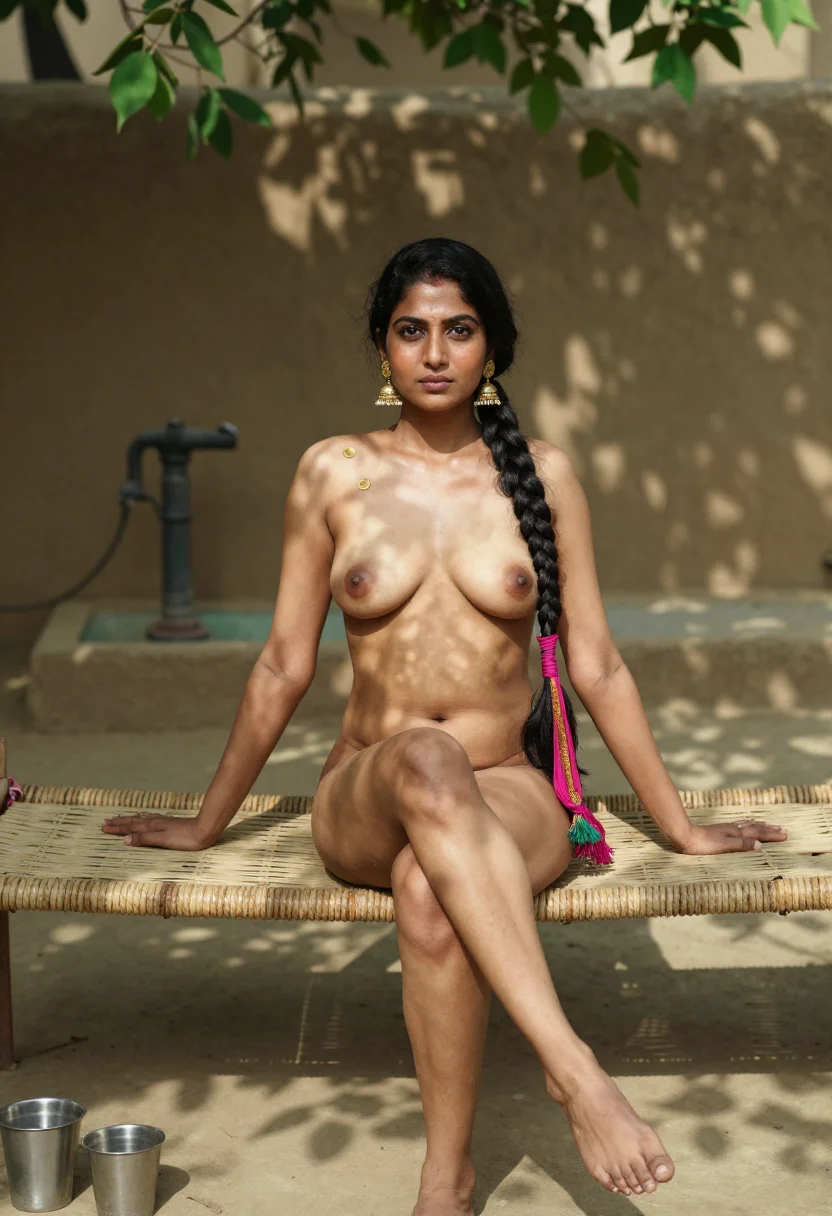
The phulkari dupatta carries the sequence: orange and magenta, slipped from the head to the shoulders and pooling in the lap in the first frame; folded away entirely on the charpai with the salwar kept on in the second; absent entirely with only the jhumka earrings and parandi ribbon left in the third. The hand-pump water is a dark patch on the earth, never a pour aimed at the frame.
Photographically the light is hard and broken — full afternoon sun on packed earth in the standing frame, a peepal's shade crossing half the seated one, sun-and-shade broken across hip and shoulder in the reclining frame. All nine images are photographic in construction and AI-generated in execution — no real person was photographed to produce any of them.
Frequently asked questions
- What is in the AI Punjabi Kudi Nudes pack?
- Nine frames in a Punjab pind courtyard during the wheat-cutting weeks. Three beside the charpai in a mustard salwar-kameez with an orange-and-magenta phulkari dupatta slipped to the shoulders, gold jhumka earrings and a parandi ribbon in the plait. Three seated on the charpai's edge with the kameez and dupatta folded away and the salwar on, water from the hand-pump darkening the earth nearby. Three nude on the charpai in the peepal's dappled shade, the jhumkas and parandi the only marks. Three frames per stage, one payment for the set.
- Are these real photographs or AI-generated?
- AI-generated, built on photographic principles — light, shadow edge and skin texture rendered the way a camera would record them, not drawn and not animated. The punjabi kudi nude register here reads as a photograph because every frame is composed from the first pixel forward against a written brief, not lifted from an existing image.
- What does the kudi wear across the set?
- A mustard salwar-kameez with an orange-and-magenta phulkari dupatta, worn first with the dupatta slipped from the head to the shoulders and pooled in the lap; then folded away entirely with the salwar kept on; then nothing but gold jhumka earrings and a parandi ribbon in the plait, held constant through all nine frames.
- Why does the courtyard feel like hers alone?
- Because it is, for the length of the afternoon: the tractor has gone to the fields with the men for the wheat-cutting weeks, and the pind's high mud-plaster walls close the courtyard off from the lane. A hand-pump bath is the courtyard's ordinary afternoon habit — the honest reason the kameez comes off, not an invented pretext.
- How is this different from the Lahori Begum pack?
- Lahori Begum is the old-city haveli register — carved jharoka screens, a takht platform, the power cut leaving the heat to do the rest. This pack is the village register instead: a mustard salwar-kameez, a charpai and a hand-pump in an open pind courtyard. Same Punjabi-woman archetype either side of the Radcliffe line, different house and different reason.
- Do I need to upload a selfie?
- It is optional. One clear front-facing photo casts the muse in your likeness across all nine frames; skip it and the house casts its own. Your selfie steers the face — it is never an image being altered.
- Is this a Candy AI or Promptchan alternative?
- Adjacent territory, different product. Candy AI is a chat you steer; Promptchan is a prompt box you refine one frame at a time. This is a pre-engineered nine-frame series delivered whole for one payment. Better for a coherent set, worse if you want to negotiate every image.
- Can I use the frames once unlocked?
- Personal and creative use. Not for commercial redistribution, not to present as a real person's photograph, and not for use against any individual.
- Is this explicit? Is there an age requirement?
- The pack contains adult nudity, and access requires confirming you are 18 or over. The muse is an adult woman composed from a written brief rather than photographed, so she is not a real person; if you cast your own face into the set, that likeness is yours and yours only.
- Who is in the photos?
- A muse you choose. 32 AI faces, none of them a real person.
Who Reaches for the Punjabi Kudi Register
- People whose search was a punjabi kudi nude and want the village courtyard register rather than a studio set
- Photographers studying how a peepal tree's dappled shade breaks hard afternoon light across skin
- Writers and worldbuilders who need one consistent pind-kudi archetype across a coherent nine-frame afternoon
- Anyone building a punjabi girl nude moodboard that has to hold one grade of light across one courtyard
- Fans of the punjabi bhabhi nude register looking for a photographic rather than illustrated take
- Collage artists who need a phulkari orange-and-magenta palette against mud-plaster walls
- Adults curious about the South Asian village-fantasy register of AI photography at an accessible entry price
About Ovid
Ovid is a house of pictures that were never taken. Most AI image tools ship one giant catalog of poses and aesthetics; the output looks like every other generated image on the internet. Ovid goes the other way. Each pack is a single editorial brief — light, styling, scene composed in the grammar of the great fashion editorials — hand-curated against real references and tested before it ships. Free preview before you pay. Packs are one-time. No template generator, no feed. A fashion house, not a catalog.