/synthetic-skin
AI Synthetic Skin Android Nudes
Make it with your museAI Synthetic Skin Android Nudes
Open this world on the wall, and make it with your muse.
all 9 frames of her, in this world ↓
The Skin-Fitting Register: The Woman Being Finished
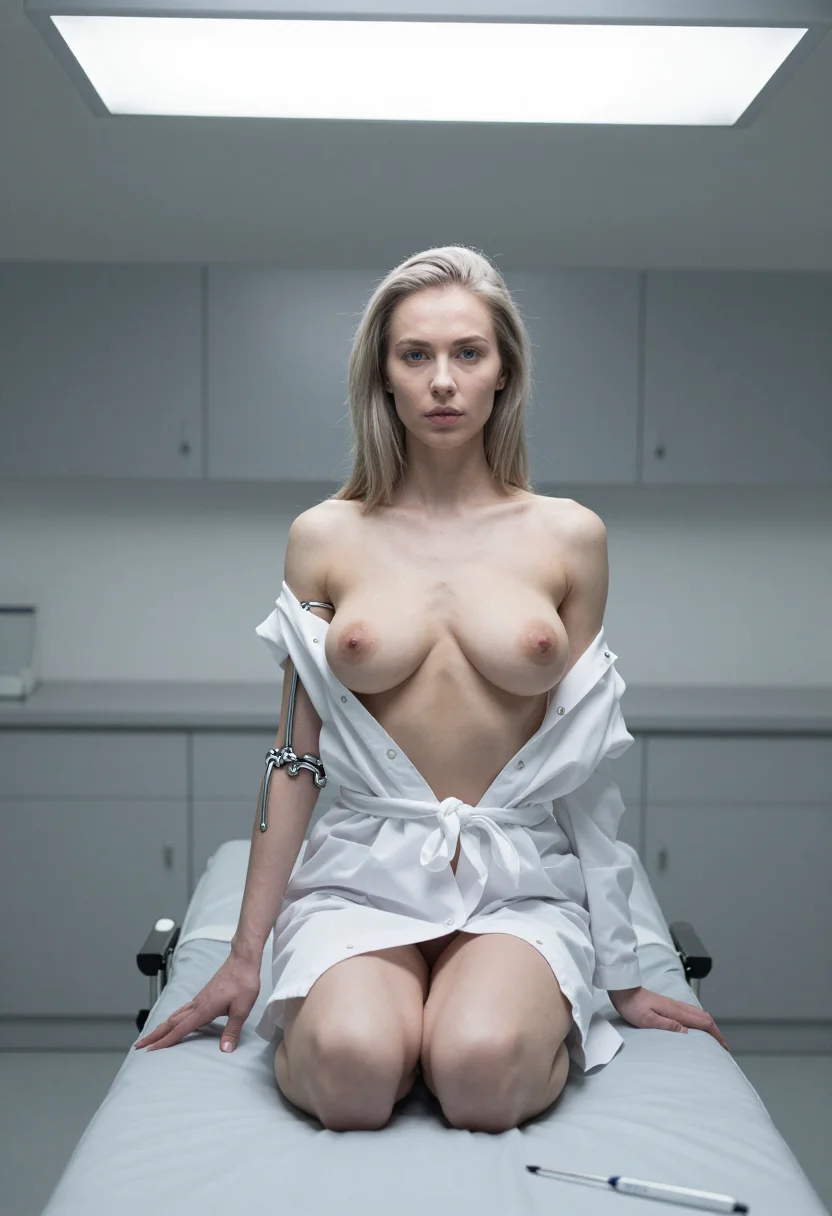
This is a lab, not a bedroom. A padded bed, a bank of flat white light overhead, steel cabinets, a tray of sealant tools, grey floor tile, and standing at the edge of it a chrome frame-mould in exactly her shape, empty. The register is clinical documentation — the photography of a procedure rather than of a person — and the whole charge of the pack comes from the subject of that procedure being an adult woman who sits upright through it with her hands resting calmly on the bed.
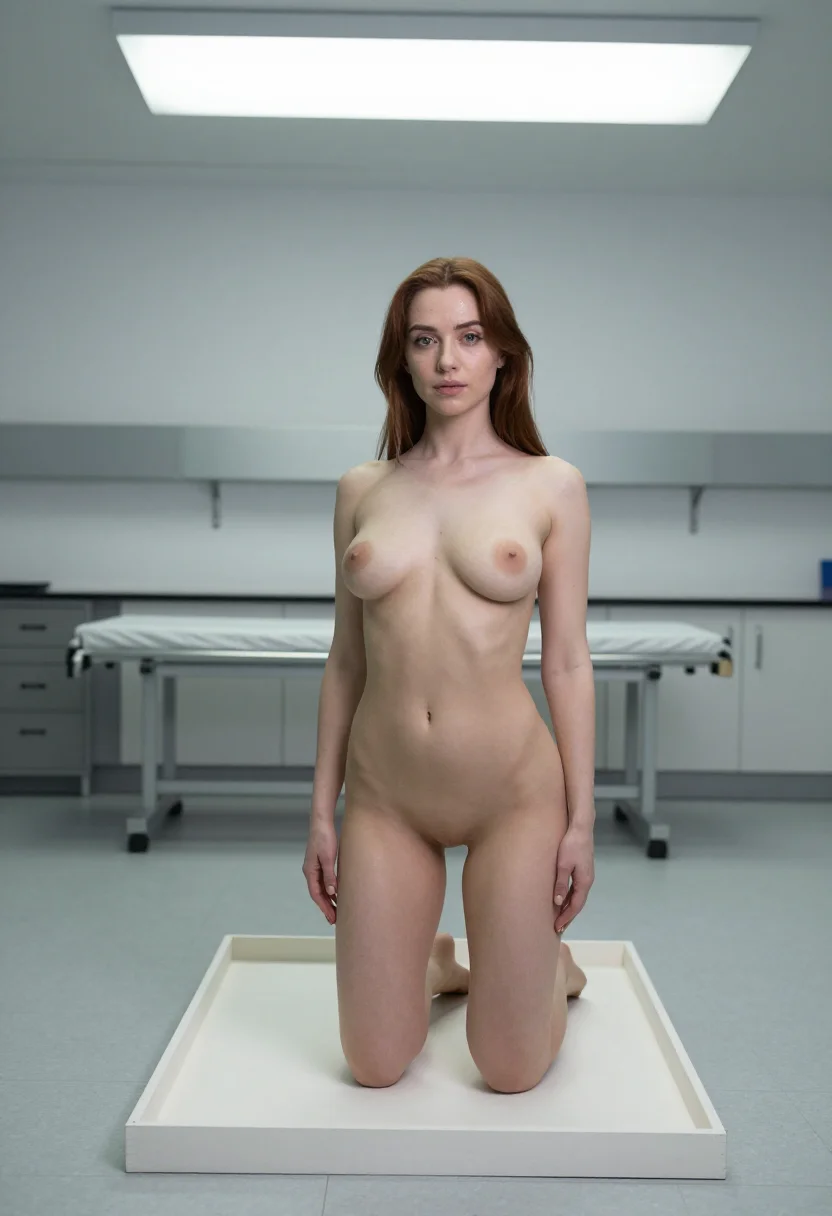
The set runs in three stages of completion. First, the arm: a skin sleeve drawn on over the chrome frame to the elbow, the rest of her already fitted, a robe fallen to her waist, the bare chrome resting on a padded rest. Then the torso sealed but the seam still open at the collarbone — one clean line, the frame's grey lattice visible under it, the robe fallen away and folded on the bed. Then finished: bare, sealed, a single faint seam left at the sternum, standing beside the mould with one hand on its shoulder and her weight on the near leg. Nothing is ever mid-motion; each stage is a settled state.
The mechanical vocabulary is rationed to four nouns — chrome forearm, collarbone seam, sternum seam, frame-mould — one per limb, and nothing else in the frame is diagrammed. Fitted skin renders as skin: matte, even, warm-neutral against the room's greys. Bare chrome renders as chrome, throwing hard speculars the skin cannot make. That single material contrast is what carries the images, and it is why the light never changes across the nine.
One light state runs the whole set, deliberately: an even overhead bank, no warmth, no drama, short soft shadows. It is the light a fitting would actually be done under, and holding it constant is what makes the three stages read as one continuous procedure rather than three separate shoots. All nine frames are photographic in construction and AI-generated in execution — specular behaviour, shadow edge, skin and metal rendered from photographic principles, not drawn and not animated. No real person was photographed to make any of them.
Frequently asked questions
- What is in the AI Synthetic Skin Android Nudes pack?
- Nine frames from one skin lab, in three stages. Three on the lab bed with the arm's skin sleeve drawn on over the chrome frame to the elbow and the rest already fitted, the robe fallen to her waist, the chrome arm resting on a padded rest. Three with the torso sealed but the seam still open at the collarbone, a clean line showing the frame's grey lattice beneath, the robe folded on the bed. Three bare and sealed, one faint seam left at the sternum, standing beside her own empty frame-mould. Three frames per stage, one payment for the set.
- Are these real photographs or AI-generated?
- AI-generated, built on photographic principles. A flat overhead bank of white light is the only source: it gives fitted skin an even matte roll-off, throws a short soft shadow under the open collarbone seam, and lets the bare chrome frame answer with hard speculars the skin cannot make. Steel cabinets and grey floor tile hold the whole frame near-neutral. It reads as clinical documentation photography, not as an illustration.
- What is the frame-mould standing in the background?
- Her own shape in dull chrome, empty. It stands at the edge of the first frames and she stands next to it, one hand on its shoulder, in the last. That is the whole arc of the pack in one object: the mould is what she was before the skin went on, and by the last third the only thing separating them is a faint seam at the sternum.
- How much of her is mechanical?
- Rationed to four things, one per limb: a chrome forearm, a collarbone seam, a sternum seam, and the mould. Nothing else is diagrammed. The fitted skin renders as skin — matte, even, warm-neutral — and the frame shows only where the skin has not yet reached. She is a synthetic woman, not a machine drawing.
- Is she clothed at all?
- In the first third a robe has fallen to her waist while the chrome arm is bare and being fitted. In the second the robe has fallen away entirely and lies folded on the bed. In the last third there is no robe in the frame at all, only the seam and the mould. Nothing is ever caught halfway off — each stage is a settled state, photographed as it stands.
- How is this different from the Showroom Model pack?
- Showroom Model is the finished display woman — a boutique plinth, three spotlights, a satin sheath lifted off by a rail hook, an audience implied by the shop itself. This one is upstream of that: the lab where she is assembled, the sleeve going on, the last seam closing. Same synthetic-woman register, opposite end of her life.
- How is this different from the Repair Shop pack?
- Repair Shop is after damage and after hours — a scarred bench, neon through a shutter, a back panel opened for the work. This is before anything has happened to her: clean white light, sealant tools on a tray, nothing opened that was not opened on purpose by the person fitting her. Repair Shop is maintenance; this is manufacture.
- Whose hands are in the frame?
- Only hers. The lab is set for a fitting — a padded arm rest, a tray of sealant tools, the mould at the frame edge — but no technician appears in any of the nine. She rests her own hand on her thigh, on the bed either side of her, and finally on the mould's shoulder.
- Can I use these as reference for a character or a story?
- Yes. One consistent synthetic woman, one location, three stages of completion under a single unchanging light is close to a character sheet by construction — useful for writers, worldbuilders and concept people who need the same body across a sequence rather than nine unrelated images.
- Is this a Candy AI or Promptchan alternative?
- Adjacent territory, different product. Candy AI is a chat you steer; Promptchan is a prompt box you refine one frame at a time. This is a pre-engineered nine-frame series — one lab, three stages of completion, one lighting logic — delivered whole for one payment. Better for a coherent set, worse if you want to negotiate every image.
- Can I use the frames once unlocked?
- Personal and creative use. Not for commercial redistribution, not to present as a real person's photograph, and not for use against any individual.
- Is this explicit? Is there an age requirement?
- The pack contains adult nudity, and access requires confirming you are 18 or over. The muse is an adult woman composed from a written brief rather than photographed, so she is not a real person; if you cast your own face into the set, that likeness is yours and yours only.
- Who is in the photos?
- A muse you choose. 32 AI faces, none of them a real person.
Who Reaches for the Skin-Fitting Register
- People whose search was a synthetic skin android nude and who want the lab register rather than a robot-girl illustration
- Photographers studying how a single flat overhead bank renders matte skin and bare chrome in the same frame
- Writers and worldbuilders who need one synthetic woman across three stages of completion instead of nine unrelated images
- Concept and industrial designers looking at a mechanical vocabulary rationed to four nouns rather than a full schematic
- Anyone building a gynoid lab moodboard that has to hold one neutral grade across the whole set
- Science-fiction illustrators after clinical-documentation framing rather than studio glamour
- Collage artists who need photographic-quality synthetic-woman material with a consistent light
- Adults curious about the android skin-fitting register of AI nude photography
About Ovid
Ovid is a house of pictures that were never taken. Most AI image tools ship one giant catalog of poses and aesthetics; the output looks like every other generated image on the internet. Ovid goes the other way. Each pack is a single editorial brief — light, styling, scene composed in the grammar of the great fashion editorials — hand-curated against real references and tested before it ships. Free preview before you pay. Packs are one-time. No template generator, no feed. A fashion house, not a catalog.