/taisho-roman
AI Taisho Roman Nudes
Make it with your museAI Taisho Roman Nudes
Open this world on the wall, and make it with your muse.
all 9 frames of her, in this world ↓
The Taisho Roman Register
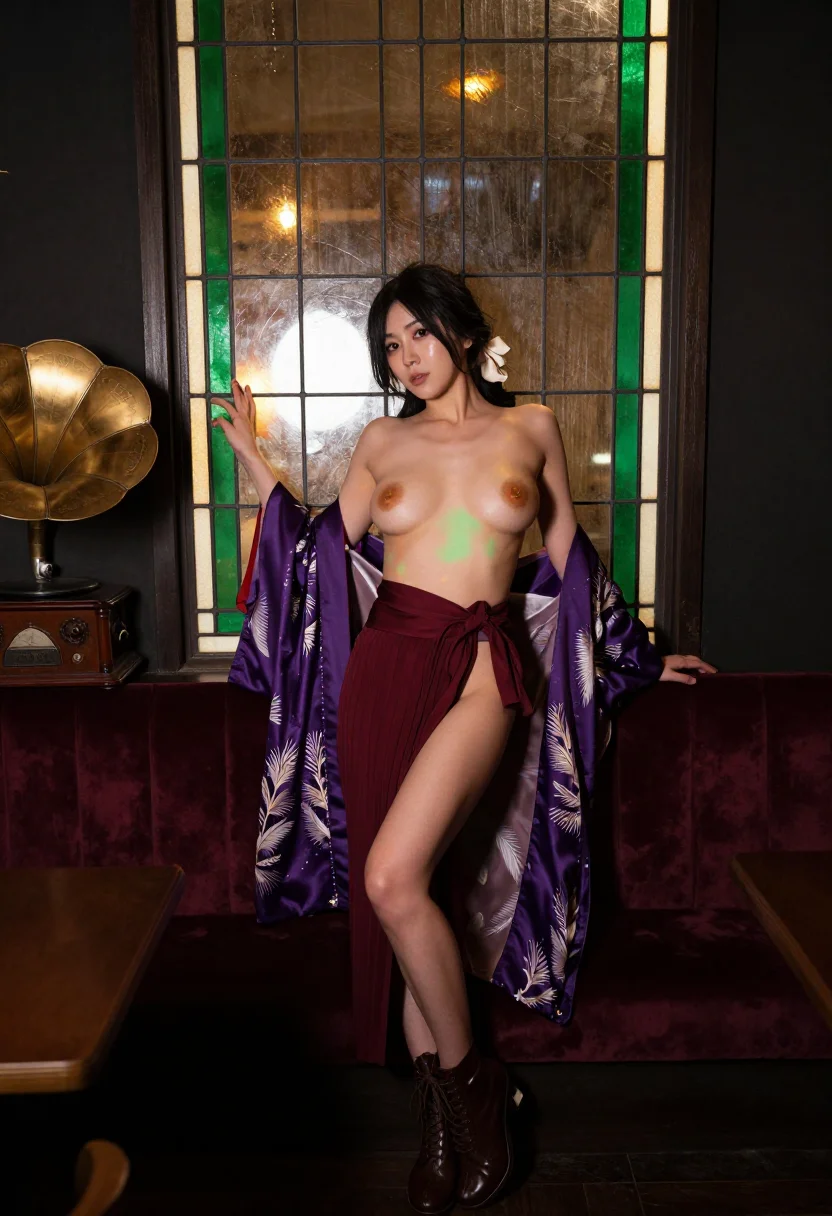
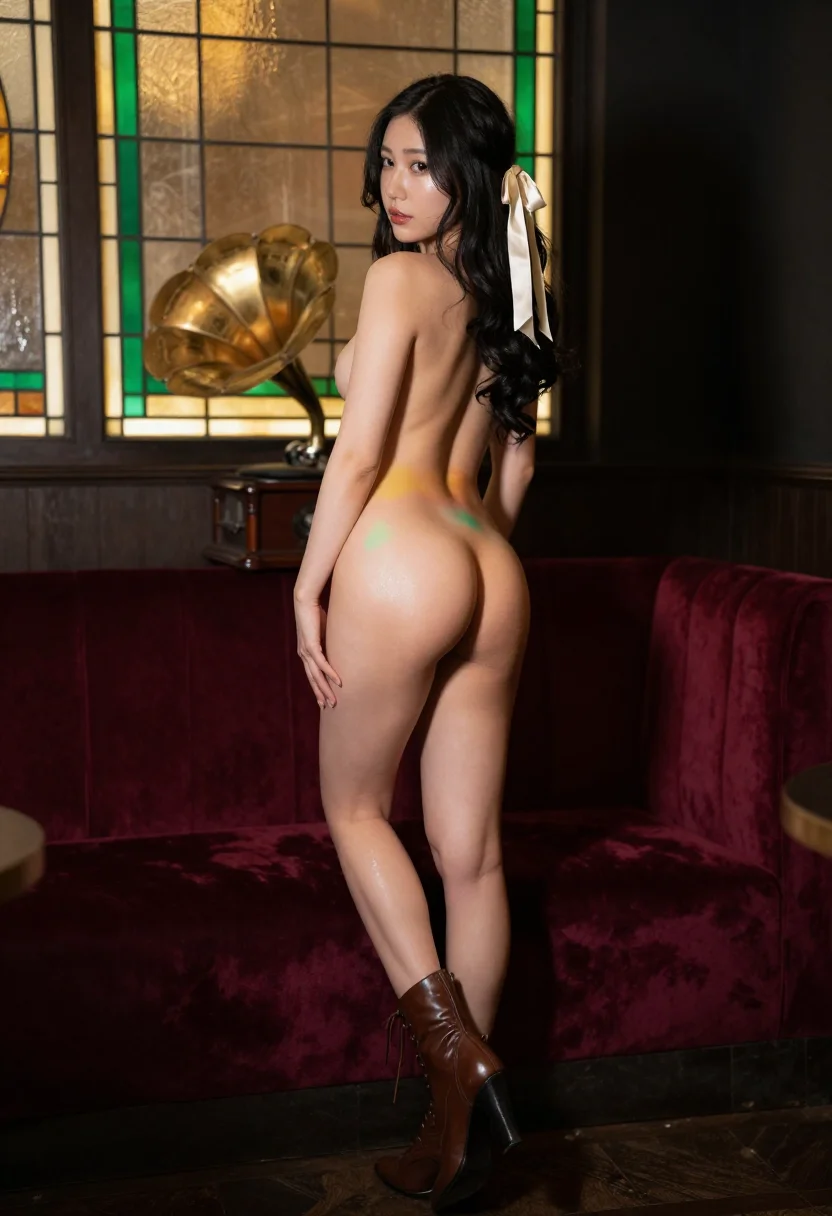
Taisho Roman is a modern-woman register: the 1920s cafe, the boots under the hakama, the ribbon that outlasts the kimono. This pack is set in a 1920s Ginza cafe of stained glass, bentwood chairs and a brass gramophone, and it keeps to one world for all nine frames.
The arc moves in three clear stages, never mid-change: seated at a marble table in a purple arrow-feather yagasuri kimono over a maroon hakama, lace-up heeled boots and a wide cream ribbon in her hair, then in the upstairs parlour after closing, the yagasuri kimono worn open to the hakama ties, boots on, stained-glass light across bare skin, then reclining along a velvet settee under the stained glass, nude but for the boots and the ribbon, the gramophone horn beside her. Palette stays fixed throughout — arrow-feather purple, maroon, brass, stained-glass amber and green — so the nine frames read as one session, not nine unrelated shots. The lace-up boots and the cream ribbon survive into the final look.
Every frame is photographic in construction — light, fabric drape, real skin texture — never drawn, never animated. The taisho roman search ends here: each frame is written before it is rendered and composed from the first pixel forward.
Frequently asked questions
- What is in the AI Taisho Roman Nudes pack?
- Nine frames in a 1920s Ginza cafe of stained glass, bentwood chairs and a brass gramophone: seated at a marble table in a purple arrow-feather yagasuri kimono over a maroon hakama, lace-up heeled boots and a wide cream ribbon in her hair, then in the upstairs parlour after closing, the yagasuri kimono worn open to the hakama ties, boots on, stained-glass light across bare skin, then reclining along a velvet settee under the stained glass, nude but for the boots and the ribbon, the gramophone horn beside her.
- Are these real photographs or AI-generated?
- AI-generated, built on photographic principles: light, fabric and skin texture, never drawn or animated. The lace-up boots and the cream ribbon survive into the final look. It reads as a photograph, not as an illustration.
- What about age and compliance?
- Access requires confirming you are 18 or over, and the pack contains adult nudity in its final third. Every frame is AI-generated; the muse is an adult composed for the set, and casting your own likeness with a selfie is your choice.
- What does the exposure look like across the nine frames?
- It moves in three clear steps, never mid-change: worn, then opened, then nude in the final stage. Nothing is caught halfway.
- What's the wardrobe and setting?
- The yagasuri kimono worn open over the maroon hakama, set in a 1920s Ginza cafe of stained glass, bentwood chairs and a brass gramophone. Palette: arrow-feather purple, maroon, brass, stained-glass amber and green.
- Do I need to upload a selfie?
- It's optional. One clear front-facing photo casts the muse in your likeness across all nine frames; skip it and the house casts its own. The selfie steers the face and nothing else.
- I searched something close to japanese vintage nude — is this the same pack?
- Close enough to matter. This pack directly answers japanese vintage nude, kimono naked, 1920s japan boudoir, ai kimono girl, hakama nude — taisho roman is the spine and every close variant of that search lands on this same nine-frame set.
- How is this different from AI Japanese Girlfriend Nudes?
- Taisho Roman is the 1920s, the cafe era of boots and hakama; AI Japanese Girlfriend Nudes is the later Showa coffee house, velvet booths and a cream soda. Search japanese vintage nude across both and they split by decade.
- Is this a Candy AI or Promptchan alternative?
- Adjacent territory, different product. Candy AI is a chat you steer; Promptchan is a prompt box refined one frame at a time. This is a pre-engineered nine-frame series — one world, one arc — delivered whole in a single unlock.
- Can I use the frames once unlocked?
- Personal and creative use. Not for commercial redistribution, not to present as a real person's photograph, and not for use against any individual.
- How is this different from a generic AI nude generator?
- A generic generator gives you one image at a time with no continuity. This is a whole session in one world, one arc — nine frames built to hold together as a set rather than as scattered, unrelated outputs.
- Who is in the photos?
- A muse you choose. 32 AI faces, none of them a real person.
Who Reaches for the Taisho Roman Register
- People whose search was taisho roman and want the full nine-frame arc rather than a single static image
- Photographers studying how arrow-feather purple, maroon, brass, stained-glass amber and green carries a set across three distinct stages
- Costume and wardrobe people looking at how the yagasuri kimono worn open over the maroon hakama reads against bare skin at different stages of the arc
- Writers and worldbuilders who need one consistent character across a 1920s Ginza cafe of stained glass, bentwood chairs and a brass gramophone
- Anyone building a moodboard around the taisho roman register that has to hold one grade across nine images
- Collage artists who need photographic-quality material with coherent, consistent lighting
- Adults curious about the taisho roman register of AI photography at an accessible entry point
About Ovid
Ovid is a house of pictures that were never taken. Most AI image tools ship one giant catalog of poses and aesthetics; the output looks like every other generated image on the internet. Ovid goes the other way. Each pack is a single editorial brief — light, styling, scene composed in the grammar of the great fashion editorials — hand-curated against real references and tested before it ships. Free preview before you pay. Packs are one-time. No template generator, no feed. A fashion house, not a catalog.